Lesson Planning
In
the fall, my lesson planning was very basic. The majority of the time I
spent planning lessons was devoted to the "activity" portion of each
lesson. I struggled with aligning the "I do, You do, and We do" portions
together, and never really thought much about planning out how to push
any higher order thinking skills. I typically thought that if an
opportunity would arise in a lesson where I could push higher order
thinking skills, then I would run with it, but I never planned how I
could create those moments within my lessons.
Most of my
objectives were well crafted, but often times my assessments did not
match the objectives (I figured out how to do that one day in a
lightbulb-over-the-head moment in my January lead teach). By November, I
was beginning to recognize one of my weaknesses as a struggle with what
Doug Lemov calls "Ratio," which is "the proportion of the cognitive
work students do in [the] classroom," (Teach Like a Champion, Technique
49). I found myself "on stage" doing most of the talking and thinking,
and one of the reasons for this was because I very rarely planned for
moments in a lesson where I could shift the cognitive work to the
students, whether it was through planned questions or planned
interactions.
Below is a sample lesson plan from one of my
Fall Lead Teach lessons on making text-to-self connections. In this
lesson plan, I didn't plan for any misconceptions, which did occur, I
brushed over the types of connections I could talk about in my own life,
but they were not explicit, nor did I give page numbers--so when I
taught the lesson, I made them up right on the spot. This plan has very
basic information that could lead to a decent lesson, but it absolutely
would not push students' thinking in more high order ways.  |
| 
Lesson Planning
Since
the beginning of the year, my lesson planning has become much more
thought-out, intentional, and specific. I have finally mastered the
correlation between "I do, You do, and We do," and make sure that what
students are doing in the "You do" independently is what I modeled in
the "I do" portion, and what students practiced with me and each other
in the "We do" portion. I also plan for opportunities to push higher
order thinking skills by planning questions. I use Bloom's Taxonomy question stems
to help create meaningful questions that will take my students'
learning to the next level. Once I started planning these questions, it
brought my students' engagement levels up, as well as the level of their
participation and their thinking.
I am also much more mindful
of the concept of "Ratio" while I plan my lessons. I add in several
questions to check for understanding at the end of each portion (I do,
You do, We do) of my lessons. Now when I plan, I do a lot of scripting
so that I can really get my ideas out, and decide exactly what types of
examples I'm going to use and how I'm going to use them. Even if I don't
have my plans in-hand with me while I'm teaching, the preparation that
has gone in to each lesson allows me to know exactly what I'm going to
say and how I plan to teach it.
Below is a sample lesson plan
from one of my Spring Lead Teach lessons about writing summaries. In
this lesson, I was very mindful about the questions that I was asking
students to not only check for their understanding, but also to push
their thinking. I also examined possible areas of misconceptions, and
addressed those in the "I do" portion. I planned out how students would
be interacting with the lesson throughout, and I made sure that my
assessment would truly measure the objective that I set out to teach.  |
|
Learning Progressions
In
the fall I had never thought much about planning in the long term
sense, or how student learning progresses over time. I relied heavily on
the AUSL Pacing Guides when I created my plans, and didn't think too
much about the different learning needs that my unique group of students
had. I didn't spend time thinking about how they needed to get to where
I wanted them, and the variety of (and often in-depth) skills that my
students needed to have to get to an expert level of understanding.
|
|
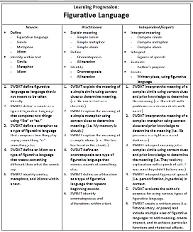
Learning ProgressionsIn
the late winter and early spring, I spent a great deal of time diving
deep into the idea of learning progressions, and how student thinking
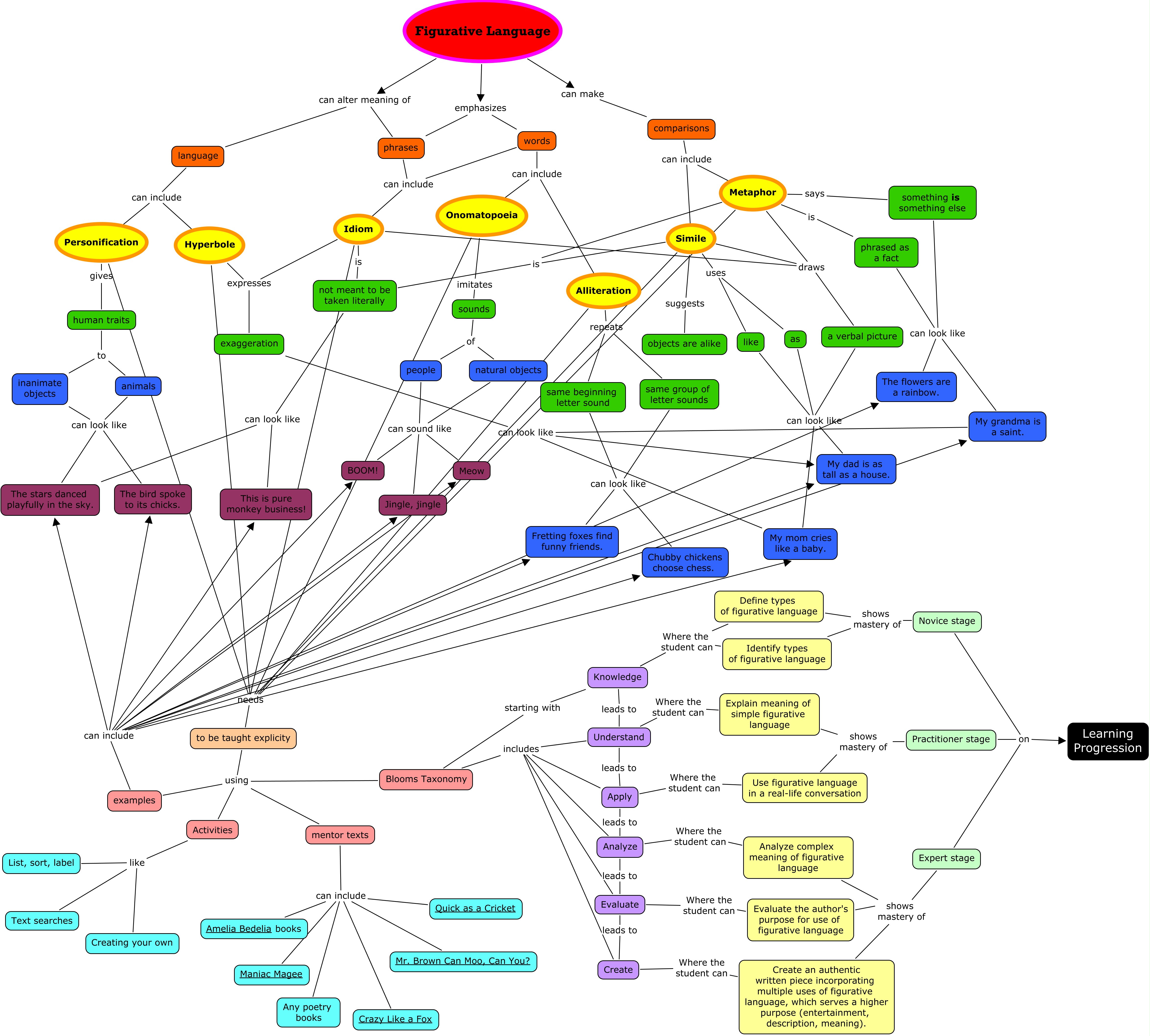
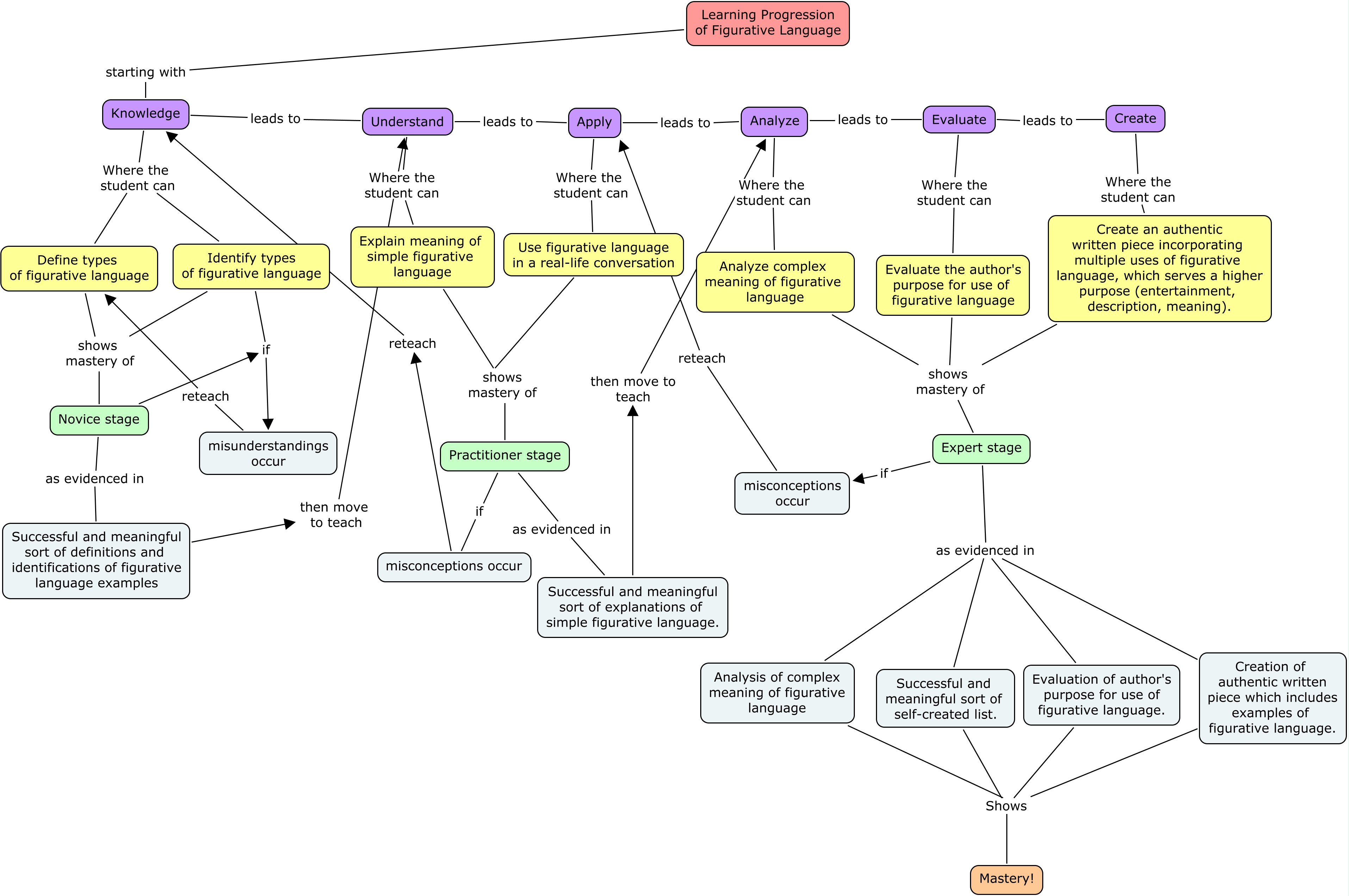
changes over time. I created a learning progression that maps how
learning progresses when learning about figurative language. In
addition, I not only created a learning progression, I also created two
concept maps that would help in the planning process. The first concept
map allowed me to plan the big ideas in my figurative language unit, as
well as strategies that I could use to teach it. The second concept map
was actually a map of my learning progression and showed how a teacher
could jump from concept to concept depending on the students'
progression of learning.
|
|
Differentiation
was an idea that I always thought was good in theory, but I never
understood how to effectively differentiate my lessons for different
types of learners. I might have tried to include some type of differentiation every once in a while for a particular student who was having trouble in a certain area, but other than that, it was a very rare for me to do much differentiation in my planning.
|
|
During
this year, I have spent a great deal of time learning how to
differentiate my lessons for various types of learners and learning
needs. It is important to differentiate lessons so that all needs can be met, and to ensure that students with special needs are being included. I really utilized the Center for Applied Technology (CAST) website to help me differentiate my lessons. Below is a UDL (Universal Design for Learning) unit I created based on Charlie and the Chocolate Factory that teaches Language Arts, Math, Writing, Social Studies, and Functional Life Skills. Each lesson is differentiated for multiple means of engagement, multiple means of representation, and multiple means of expression. In addition to those differentiations, specific accomodations and modifications have been put in place for students in my room with IEPs. The UDL lesson plan format has taught me to really think about the different learning needs that my students have. I have also begun to incorporate the idea of learning progressions into my UDL as I plan, which has really created a wonderful cohesion between the two, and has made it easier to differentiate when I plan. |
 |
|